


.png?width=720)

Trucks and Fins is a huge present to the whole skate community - not just for the skating people, but also for shops, builders and schools. Super easy to use and can't believe how complete it is.
Pascal Lieleg aka Official Bowlshit

The design of Folkestone51 could be a metaphor about life: the higher you go, the wider and greater your range of action. But it’s just a mind trick to take the visual weight off the building. The man who reveals this is Guy Hollaway, the architect responsible for this disruptive, comprehensive, and catchy building in Kent, in the Southeast of England. A 17 million pounds project that opened in 2022. We had a talk with Guy Hollaway, the proud architect of F51, the result of a long and sometimes painful process. 'I was F51's first blood injury', he says with a smile.

It's all due to a man called Sir Roger de Haan, who ran the Saga group, which employeed around 2.500 people, literally almost the whole population of Folkestone. 15 years ago he sold the company for 1,6 billion pounds and decided that his legacy would be philanthropic. He invested 15 million in the town, in arts, sports, education, in regeneration. He's also currently building around 1000 units on the sea front. It´s a one-man regeneration. I've been very fortunate to be on this journey with him and have been his main architect for this regeneration of Folkestone.
About seven years ago he phoned me up and said ‘Guy, I’m thinking about buying a peace of Folkestone’ and I said ‘don't you own it all anyway?’ and he answered ‘yeah for sure but there's this piece of land’, located on the edge of one of the most deprived parts of Folkestone, if not in the Southeast of England. Kids there have no money and are very deprived. It's a desperate area. He said 'look, if we are going to put a thousand units there we need places for people to be’.
I said ‘what about a multi-storey car park?’ He said ‘yeah, OK, good idea, go away and design that’. I designed it and showed it to him. He said ‘Guy, this is a bit boring’ and I said, ‘It’s a car park, what do you want?’. Then he told me that there was an old skatepark at the sea front and asked me to think about a way to integrate skate in this car park, put it on the roof, something like that.’ When I showed the design to him he said ‘this car park is boring, but the skatepark is amazing’. And then he asked me to think about this idea.
 - Copy.png) That’s when I designed this multi-storey skatepark with multiple levels. I got pretty excited; we worked on this about six months and we came up with this idea of creating a building which was about adrenaline sports. It has climbing and a boxing club too. There are all sports which are about yourself and your own journey.
That’s when I designed this multi-storey skatepark with multiple levels. I got pretty excited; we worked on this about six months and we came up with this idea of creating a building which was about adrenaline sports. It has climbing and a boxing club too. There are all sports which are about yourself and your own journey.
This got buzzy around the world and we suddenly thought ‘s*** maybe we got an idea here’. Even Tony Hawk called me, saying ‘I’ve seen this skatepark, are you going to build this thing?’ And I said ‘yeah!’ We did, we built it, it took a long time, but that happens when you try to reinvent something… What we wanted to do was to create a skatepark great for the beginners and for the local kids with an international standard. And now people come from America, Australia, Asia to skate here. We have put the town on the map. We are going to create a whole new generation of kids who skate. We have this programme where if your local and under sixteen you can skate there for one pound a month, which is pretty nuts, so suddenly skate becomes incredibly accessible.

Yeah. When I wake up in the morning my thought is ‘where are my car keys’ but this generation wakes up in the morning and thinks ‘where’s my bike, where’s my skateboard’, their mobility gives them a sense of independence. This skatepark becomes a training ground. What we wanted to do was to create something they could really belong to and how can we rethink the perception of skateboarding in the world. I had some people calling me from America, fascinated with the fact that we were putting the skatepark in the town centre, when they say ‘we build this skatepark out of the town’. Sometimes it gets territorial and doesn’t become so accessible. What we found is that we have these different levels, and we can have an all-girl evening or a rad dad’s night, we have school parties, birthday parties… it’s a very interesting concept.
Yes, a gift from Sir Roger. A 17 million gift. The business plan in a nutshell is this: the building makes money with the climbing wall, boxing club, through people out of town who come and pay to skate or roll, the Cafe, events… and the idea is that the money it generates is to pay the costs. I spent a lot of time making this business plan and it’s working so far. The only way that it works is that you have a building that is efficient to run. It’s a cold building so there's no heating in there, it has minimal electricity demands.
Yes. What Sir Roger does with all his projects is he creates a trust for the building with people who seat on the board and make all the decisions about the management of the building. As part of the trust there’s a network regarding other sports buildings, schools programs, we have all these connections with the town to get these kids into the building.
“I also wanted to make something very urban and cool. If the skate community don’t like what you’ve done they will reject it”

I wanted to do a smaller building on the ground floor, where there is a café. Very visible and welcoming on the ground floor and a building that gets bigger as it goes up because we needed more space. But then I created some real architectural trickery: if you look at the buildings next to it it’s a three-storey building that looks bloody tiny but this is the equivalent of an eight-storey building, but it doesn't feel like that. It’s because the windows are two storeys high and there are big panels, so it plays tricks on your mind. The building looks and feels a lot smaller because you take the weight out off it. You don’t have angles into the ground, it curves away from you, so you never see the end of the building. I also wanted to make something very urban and cool. If the skate community doesn't like what you’ve done they will reject it. So it's a very big challenge to create something that is cool and is going to be accepted. Normally if you give that to the council or local authority of the government, they will kill it in seconds!
We did things like we invited the skate community to submit designs for the murals in the skateparks. We had 120 young people put in designs and we put all those designs on the skateboards in the cafe, but we selected ten that went into the park, on these huge murals. It gave them a sense of ownership even before we opened. We did a lot of work with them in terms of consultation. Look: I'm not cool or I’m not what they think is cool, so they dictate what is cooler and everything else. The building was really well received by the skate community.
“I don’t think it’s ever been attempted before to put a concrete bowl up in the air”
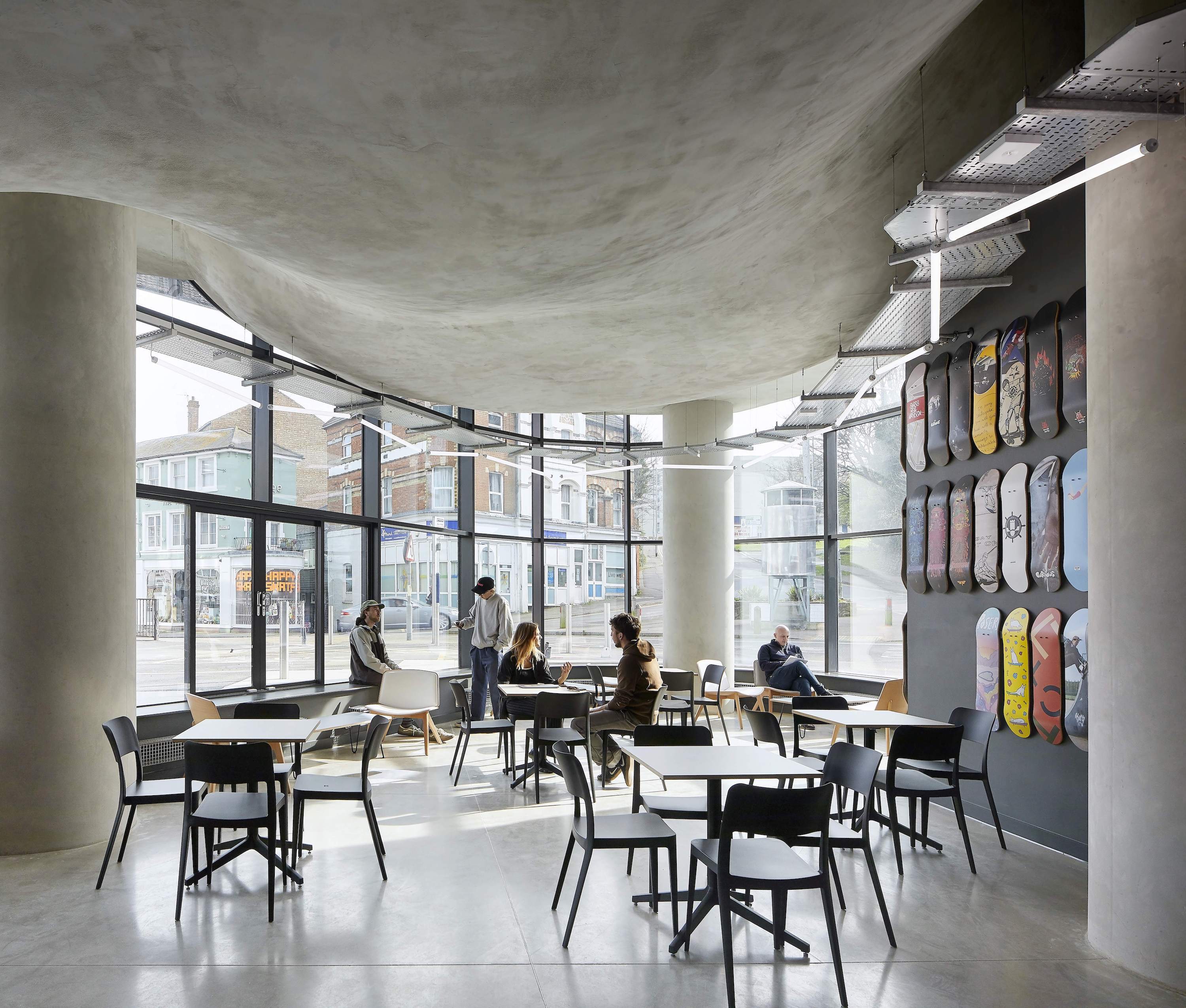
A nightmare! It’s one of those moments when you think ‘why the f*** I did that’ [he laughs]. I don’t think it’s ever been attempted before to put a concrete bowl up in the air. It was built by Maverick, they are extraordinary. We put decks and colour styling moulds like a jigsaw puzzle and late we reinforced it with concrete into the mould and took the moulds away and that formed the bowl. But that bowl is a beam as well, so it’s hard to tie the whole thing together, it’s pretty crazy. It’s quite a thing when you walk in, and you feel the bowl above your head. It’s heavy, it’s nuts! It’s a roof with architecture, engineering and skate coming together. I really don’t think anybody tried to do that. We invested in skate in such a way to celebrate the architecture, the engineering, and the culture of skate. It elevated the skate, you say ‘you have changed lives, you give young people an identity and you’re worthy to become an Olympic sport’. Maybe we will have the next Olympic skater from Folkestone, who knows?
We used a replacement of cement. It’s a bio product from steel manufacturing. It’s something more sustainable, i’s a low carbon concrete. Beyond the bowl, which is 2,8 meters deep, you got a street flow and a flow park, those are timber floors so that in 10 years’ time we can take timber floors out and replace it. The structure of the building goes into steel frame above the concrete so that just made the building a lot lighter as we went up through a little bit more cost effective as well.

Up to 170 people on each floor, over 600 in the building. What tends to happen is we have a competition on just one floor, so it's like if you’re in a street exhibition you are not in the bowl. It’s pretty rare to have many people across all the floors. The climbing wall is more commercial. We have the tallest climbing wall on the Southeast of England Midlands and we have bouldering. I think if I had more time, I probably would have made the climbing centre bigger because it’s so popular.
“When as I was growing up here all you could think about was leaving the town as quickly as you could. We wanted to upgrade their lives by education sports, to access to an adrenaline building like this. Maybe we can reverse brain drain”
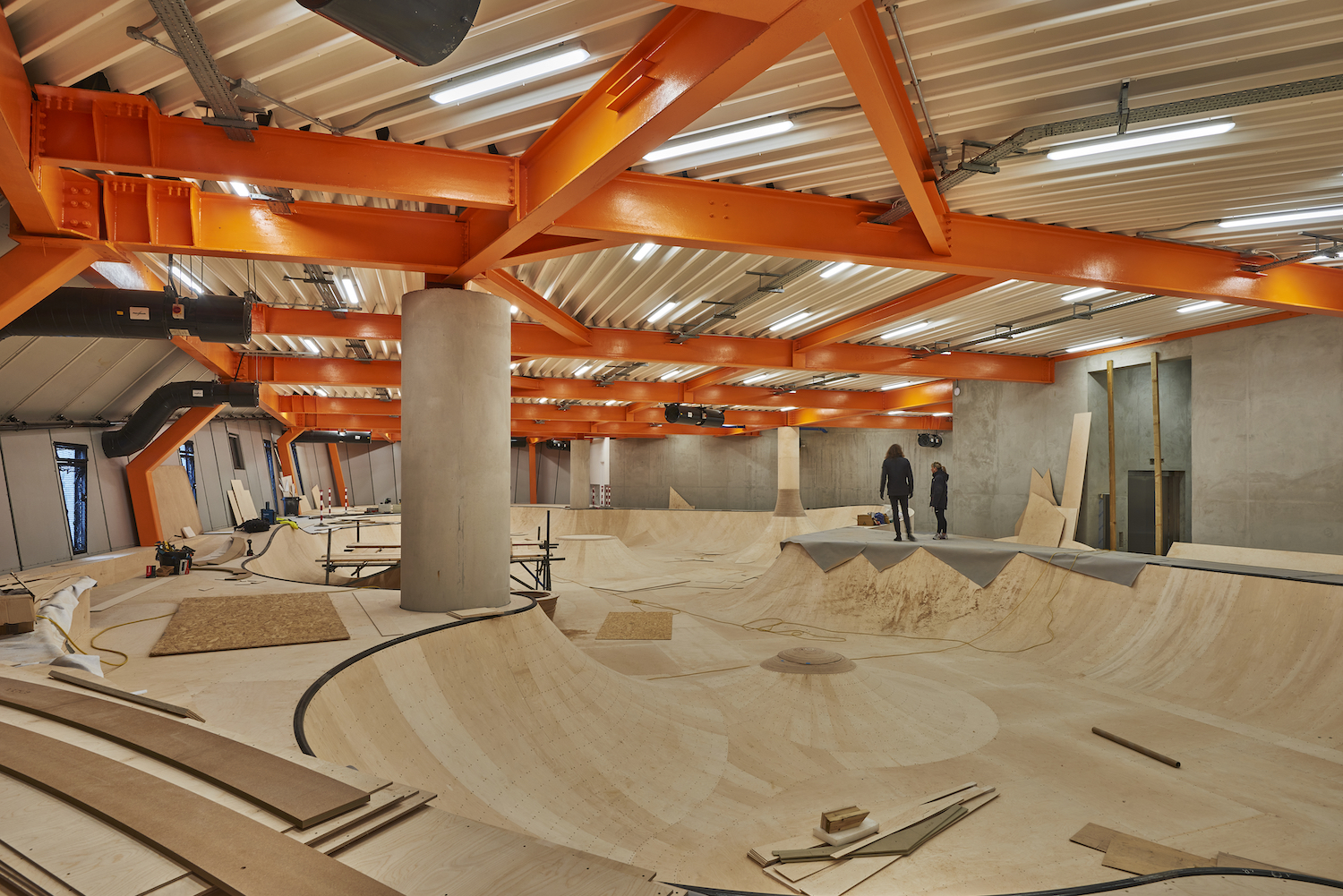
Skaters are free spirited. I’m generalising, but they don't think ‘I’m going to skate in two weeks’ time so let’s book it’. It doesn’t work like that. They just look at the weather and make a decision. The building needs to understand the culture, but you can make money through climbing centres, bouldering and the boxing club. This is a club where people come to train, and we saw the membership triple. In the beginning we had two girls and now there are 43 girls. It’s pretty insane. All those sports coming in interactive, it’s about their own journey but what we wanted to do was a larger regeneration story, we wanted to upgrade their lives by education sports, access to an adrenaline building like this. This means that the memory of their upbringing might be positive and we can reverse brain drain.
Basically when as I was growing up here all you could think about was leaving the town as quickly as you could, but now if you can create a memory which is supposed to be warm to your community and your family and everything… OK we are going to lose a lot but if we could capture maybe 30 per cent of those kids that will pay by 10/20 times over there because you're keeping the best brains, you’re keeping people in the town.

I'm not a great skater at all. I started skating when I was a kid and had a big injury, my tooth went through my bottom lip, it put me off a little… Lately if prefer to surf to be honest. I was the firs blood injury at F51. I injured myself quite seriously and had to go to the medic room on the opening day, actually [he laughs]. I love skating and I love what it gives. To be a good skater you need coordination, but you have to have discipline, the process of training and mental training and having dimensional awareness… Besides that... It’s often you find the Skateworld opens itself up to the creative industry... if you just look at fashion, trainers, if you think about the music industry, if you think about design and arts… it’s so accessible to the creative industry and creative industry is the largest growing industry now… if we could inspire some of these young kids through skate to see opportunities, to entering into work or into business and start monetize in some sort of way… If you look Netflix documentary ‘Dogtown’ all those guys came from some sort of former creative industry. So, we think these things create an opportunity and access to people.
Yes. Because of the weather, the convenience, the set up for challenges, because of the size and the scale of it. There’s a huge section of skaters, those who are the independent thinkers, they are people who skate anywhere, they are just obsessed. Historically there is this perception that skating is anti-behaviour or something else. And what this building does is to fuse these things together and opens up to another generation which has more girls getting involved and the rad dads who started skating again with their kids, or scooters or bikers… so if it becomes far more accessible it opens it up and then you can start to make financial models to work.

This project is unfortunately unmeasurable. If you’re under the age of 16 and you’re a local you pay a pound a month. But that’s just Roger’s gift. We’ve looked to the model of F51 and started applying that on The Wave Project and other projects. We are starting to work out how we can make it accessible and revivable. You need these philanthropic projects. It took us a few years to build this, because we didn’t want to create a white elephant.
“Through mobility that you become fitter and healthier, then I think skate will transform how we live”
I think one of the most interesting things by watching the Olympics was… if you watch the athletics or other sports if you come second it’s like their world ends, like they've failed, but in skate there are no winners or losers. You fall over and you get up, you learn from your mistakes and from falling, and life is a bit like that. I loved watching skateboarding during the Olympics because if you became 6th or 8th they were celebrating. Because when you skate everything's going to connect it once. Any multiple things could go wrong in any second, it’s like when you’re catching a wave, and you try to put a combination of something together. Skating is about yourself and about limits and that’s why it has so much potential in the future.
We will become more mobile in a different way, and we think about our cities, how we move around our cities, the 15 minute cities, and if we can create a generation of cyclists and skaters and scooters, these very contractions in the same way… If we can start to think about mobility in a different way we could start to think about fitness, wellness, well-being… Through mobility that you become fitter and healthier, then I think skate will transform how we live. It’s a really strong message. And that’s why we need these kinds of projects to nurture the next generation but also to educate the generations that exists.

Join the Trucks and Fins community and receive exclusive news, giveaways, access to subscribers-only
-contests, discounts from our partners and much more directly from us!

Trucks and Fins is a huge present to the whole skate community - not just for the skating people, but also for shops, builders and schools. Super easy to use and can't believe how complete it is.
Pascal Lieleg aka Official Bowlshit

Trucks and Fins is a great resource for checking on local spots if you are traveling or planning a road trip! A one stop resource that is constantly updated with the newest projects as well as those bucket list locations worldwide. The intuitive UI features gps coordinates as well as useful information about shops nearby.
Architect Betonlandschaften

Trucks and Fins provide a great service. Its quick and easy to use and has such a vast amount of parks included, not just in the UK but worldwide. CANVAS Spaces support the cause and fully back what they are doing.

Our skate community has been crying out for a comprehensive guide to global skate spots. Trucks and Fins should be commended on their dedication to mapping the world's STOKE!
Maverick Skateparks

Trucks and Fins brings all of the world's skateparks to you all in one convenient place through their endless search for parks around the world. They have park locations, details, images, and more to help plan your next skate quest wherever that may take you. We appreciate their dedication and passion for skateboarding and the amazing gifts that skateparks and skate spots are.
Steve Zanco, Skatepark Respect

A big part of skateboarding is about finding Animal Chin - your spirit animal, or in other words: whatever gets you stoked. Could be the right people to roll with, or that special dream terrain. Trucks and Fins has all the best skate destinations in one place; a map of stoke in your hands.
Jan Kliewer, Yamato Living Ramps
